No products in the cart.
Progressive vs. Bifocal Glasses: Which Vision Solution Do You Need?
If you are struggling to read fine print while also needing glasses to see across the room, you aren’t alone. Progressive glasses (also known as progressive addition lenses or PALs) offer a modern, seamless solution to vision changes by combining three visual fields into a single, line-free lens.
How Progressive Lenses Work
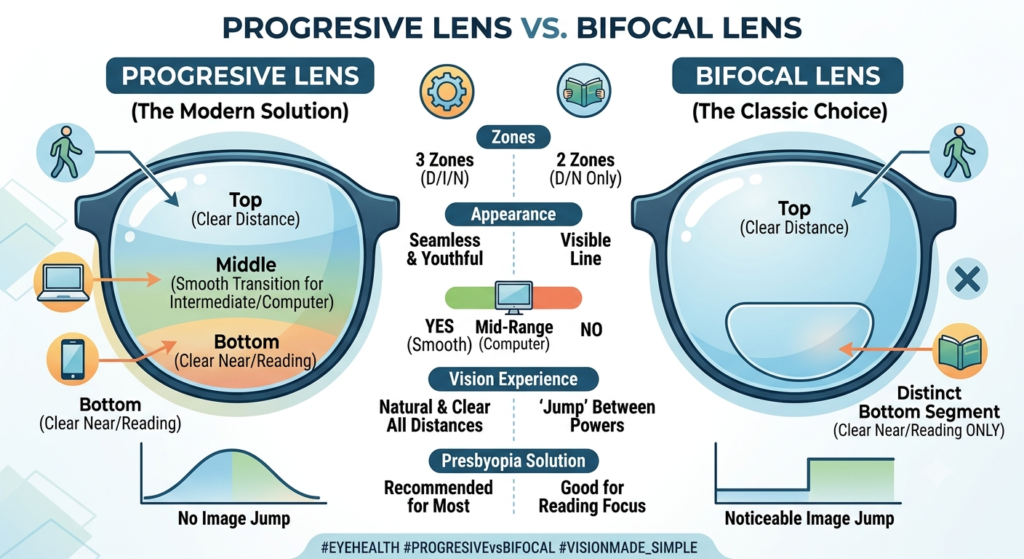
Unlike traditional eyeglasses, progressive lenses feature a gradual change in magnification power from the top of the lens down to the bottom. This allows for a natural transition between different viewing distances:
- Top Zone (Distance Vision): Optimized for far-away viewing—ideal for driving, watching TV, and walking.
- Middle Zone (Intermediate Vision): Designed for mid-range tasks like working on a computer, looking at your car dashboard, or reading store shelves.
- Bottom Zone (Near Vision): Tailored for close-up tasks such as reading books, using your smartphone, or doing detailed work.
Because the transition between these vision zones is completely smooth, you won’t experience the sudden “image jump” common with older multifocal designs.
Key Benefits of Progressive Addition Lenses (PALs)
- Clear Vision at Every Distance: Effortlessly switch focus between far away, mid-range, and close-up views. buy it from arnoptical.com
- No Visible Lines: Seamless lens design eliminates the telltale line found in bifocals for a sleeker, more youthful look.
- Single-Frame Convenience: Say goodbye to switching between separate reading glasses and distance glasses.
- Optimized for Digital Devices: The intermediate zone makes progressive lenses ideal for computer screens and smartphone use.
Who Should Wear Progressive Glasses?
Progressive lenses are primarily recommended for individuals over 40 years old who are experiencing presbyopia—a natural, age-related decline in the eye’s ability to focus on nearby objects.
They are also an excellent choice for anyone who requires:
- Nearsightedness (Myopia) or Farsightedness (Hyperopia) correction.
- Astigmatism correction alongside reading assistance.
- An all-in-one vision solution for daily, uninterrupted wear.
Progressive vs. Bifocal Glasses: What’s the Difference?
When deciding between progressive lenses vs. bifocals, understanding how they function can help you make the right choice for your lifestyle.
| Feature | Progressive Glasses | Bifocal Glasses |
| Lens Appearance | Smooth, line-free surface | Distinct, visible dividing line |
| Vision Zones | 3 zones (Distance, Intermediate, Near) | 2 zones (Distance and Near only) |
| Visual Transition | Gradual, continuous transition | Sudden “jump” between zones |
| Aesthetics | Modern and natural | Traditional look |
| Adaptation Period | Takes a few days to a week | Quickly adapted to |